Independent species review: pending. Source-check date: 2026-09-05.
Report a care correction · Offer a species reviewArticle changes
- 2026-09-05 · Added a species-scoped care summary, cited planning references, ownership considerations and setup checks.
- 2026-09-08 · Expanded practical preparation, maintenance and observation sections, with scoped sources where applicable. This update checks the new material; independent species review remains pending.
At a glance
- Identity first
- Confirm species, locality and lineage before selecting final climate settings. ↗
- Housing
- Manual assessment: adult size and sex matter; allow full-body stretching. ↗
- Provisional climate reference
- Dubia trade-animal guide: basking about 32°C, cool side 21–24°C, humidity 40–60%. Confirm applicability. ↗
Dimensions are adult planning references in length × width × height, not a welfare certification. Match housing to the actual snake and retain usable climbing, shelter and temperature choices. Named source targets are starting references, pending independent species review.
Use this guide as a starting point alongside the detailed sources below. Health concerns, unexplained changes in behavior, or feeding problems belong with a reptile veterinarian.
Resolve identity before climate
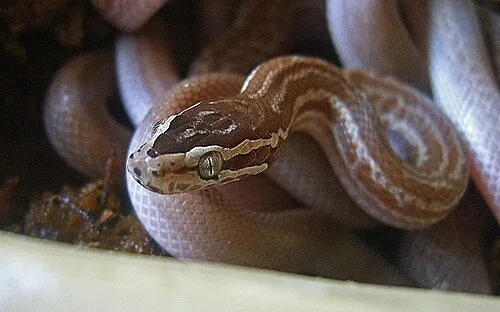
“African house snake” is a trade label, not enough identification for a final care plan. This entry introduces commonly kept brown/Cape house snakes labeled Boaedon capensis or B. fuliginosus. The Reptile Database documents longstanding confusion and a 2026 reassessment. Obtain locality, breeding history and the current identification from a knowledgeable breeder. Black, striped, Namibian and other house snakes must not inherit this page’s climate automatically.
Space and security
Sex and identity materially affect adult size, so the finder requires a manual housing assessment. Choose an enclosure permitting full-body stretching and add sheltered climbing and burrowing opportunities. House singly. Thin hatchlings can exploit the overlap between sliding doors, making suitable door design and a careful gap inspection essential. Have a secure temporary container ready before cleaning, rather than improvising while holding the animal.
Heat and lighting reference
For the common trade animals it describes, Dubia’s care sheet gives a 90°F (about 32°C) basking area and a 70–75°F (about 21–24°C) cool side. These are provisional references, not settings certified for all Boaedon. Confirm the identification before adoption and agree a coherent climate plan. Regulate heaters and use independent probes. Offer daytime UVB with shade, following fixture-specific distance guidance and accounting for climbing height.
Humidity is identity-dependent
Dubia uses 40–60% humidity with a humid hide; specialist House Snake Morphs & More describes different conditions among the forms it keeps. That disagreement is a reason to retain lineage information, not average numbers into a universal target. Record readings and complete sheds, keep refuges clean, and ask an experienced keeper or veterinarian to assess persistent problems.
Food, cover and routine
Obtain a dated record demonstrating independent feeding on suitable thawed prey. Whole mice are a usual captive food, sized for the individual; adult females may require substantially different meals from small males. Provide tight-fitting hides and covered travel routes, which the specialist breeder emphasizes for feeding security. Keep offered and eaten meals separate in the notebook. Check water and waste daily, and allow settled feeding before increasing optional handling.
Commitment and costs
Published trade-name care sheets give conflicting longevity estimates, so we do not assign a firm lifespan to an unconfirmed identity. Plan a long commitment and obtain species-specific expectations. Our standard budget tier includes adult housing, heat control, UVB, small-prey availability and veterinary care. The necessary step before purchase is resolving what snake you are actually preparing to keep.
Ask for evidence behind the animal's label
House Snake Morphs & More reports different care experiences among the forms it keeps and stresses close-fitting cover for hatchlings. That is valuable firsthand context, but a broad house-snake label cannot substitute for the identity and history of an individual.
Request breeder records, locality where documented, hatch date and recent voluntary meals. Keep the exact original label with a dated note if the identification is later revised. Do not infer captive origin from a price, colour or reassuring sales description. Mark missing evidence as unknown in the record. This makes later specialist advice more precise and avoids building a detailed climate plan on an undocumented assumption.
References: House Snake Morphs & More — firsthand species differences and cover
Inspect security at the scale of the hatchling
Photograph door overlaps, probe entrances, vent fittings and any opening exposed when a removable panel is lifted. Keep that checklist with the build plan and repeat it after replacing equipment. A thin youngster's enclosure should be evaluated before it contains the animal, when small defects are easier to correct.
Prepare a labeled, secure holding container and a place for it during cleaning. Keep closure hardware within reach. Show a backup keeper exactly how each door is checked and where the snake commonly shelters. Avoid a care routine that leaves one panel open while supplies are fetched from elsewhere. The goal is a complete service sequence that can be repeated without improvisation.
Record gaps in the arrival history for the veterinarian
List known and unknown details separately: previous housing, other reptiles present, feeding history, examinations and treatments. Preserve any original documents. An animal described as captive-bred may still arrive without a complete medical history; a clean record should show that distinction.
Arrange veterinary assessment and an appropriate separate arrival setup. If parasite investigation or treatment is advised, save the veterinarian's instructions and follow-up dates. Do not turn a breeder's general deworming recommendation into an unsupervised medication plan. Record weight, meals and relevant observations through the settling period, so a concern can be discussed using a timeline instead of a general impression that the snake seems uncomfortable.
Sources & further reading
Read the full recommendations and check details for your animal, equipment, and local conditions.
- Reptile Database — Boaedon capensis scope
- Reptile Database — fuliginosus confusion and reassessment
- House Snake Morphs & More — differences between forms
- Dubia — care reference for animals labeled B. fuliginosus
- Reptile Cymru — trade-name size and longevity discussion
- Northampton Reptile Centre — house-snake feeding and daily care
Compiled September 2026. Original summaries; not individually reviewed by a veterinarian.